
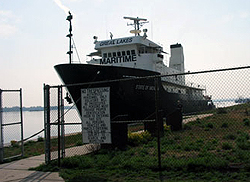
T/S State of Michigan
The Great Lakes Maritime Academy's Training Vessel, T/S State of Michigan, Visits the Port of Duluth-Superior
May 21-22, 2007
The Great Lakes Maritime Academy’s (GLMA) training vessel, State of Michigan, made a port call to the Twin Ports of Duluth/Superior on May 21-22, 2007, as part of GLMA’s Spring 2007 Training Voyage which featured port calls around the Great Lakes. While in the Twin Ports, GLMA, an affiliate university of the Great Lakes Maritime Research Institute (GLMRI,) engaged the port community in many ways.
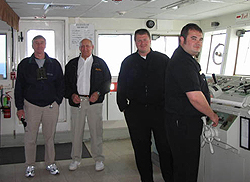
T/S State of Michigan
The vessel was open for public tours and its visit was highlighted in local newspapers and TV/radio stations. Rear Admiral John Tanner, GLMA Superintendent, and Cadets Chris Reid and Sal Randazzo were involved in Maritime Day events, as Admiral Tanner spoke on behalf of GLMA and the cadets were flag bearers. Coinciding with GLMRI research on alternative fuel usage by Great Lakes marine vessels, the State of Michigan took on a bio-diesel fuel mix at the Murphy Oil terminal in Duluth.
GLMRI Assistant Director Carol Wolosz and Associate Researcher Stacey Carlson joined the State of Michigan on their voyage from Duluth to Sault Ste. Marie, Mich., as the vessel and crew began its last leg of the journey to their home port of Traverse City, Mich.
After threatening skies and cold and windy conditions passed through the Twin Ports the day prior, the State of Michigan departed the Twin Ports on Maritime Day, May 22, under clear skies and with calm waters.
While making the voyage from Duluth to Sault Ste. Marie, Wolosz and Carlson were provided a first hand look into the Great Lakes Maritime Academy and life aboard ship. They learned about shipboard activities including watch-standing, plotting positions on a chart, line-handling and locking procedures. They observed cadet life, had the opportunity to talk with many cadets about where they had come from and what they hoped to do, and learned proper painting techniques and how to conduct late-night raids on the ship’s refrigerators. The cadets showed competence in their new responsibilities, respect for their new jobs and an excitement about their futures.
GLMA’s Spring Voyage is an opportunity for first-year cadets to gain valuable underway experience and hands-on training while navigating across Lakes Superior, Huron and Erie, and through the St. Marys, St. Clair and Detroit Rivers. The Spring Voyage is a precursor to cadets working aboard Great Lakes commercial ships for the remainder of the summer.
The Great Lakes Maritime Academy trains men and women to serve as business professionals and merchant marine officers aboard Great Lakes and ocean ships. The school is designated as a regional maritime academy and the nation’s only freshwater academy.
Graduates are awarded both a bachelor's degree in business administration and an associate's degree in maritime technology and are qualified to take Coast Guard license examinations for a third mate Great Lakes or oceans, first class pilot Great Lakes, or third assistant engineer, steam, and motor vessels.

